
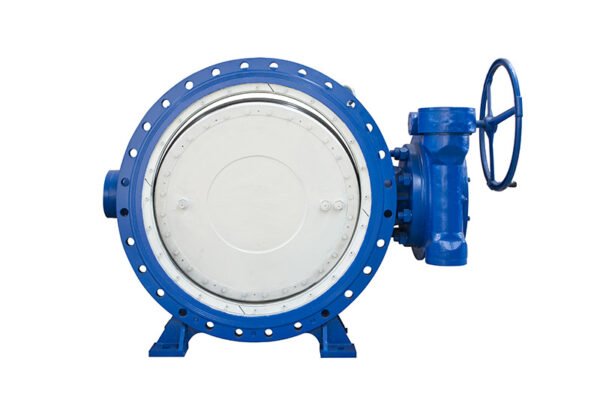
Appearance and Connection Dimensions

| Model | DN | L | H | H1 | E | D | D1 | b | n-d | ||||
| PN10 | PN16 | PN10 | PN16 | PN10 | PN16 | PN10 | PN16 | ||||||
| XQ342H -10Q/16Q -10C/16C |
250 | 165 | 830 | 224 | 425 | 395 | 405 | 350 | 355 | 22 | 22 | 12-23 | 12-28 |
| 300 | 178 | 895 | 279 | 560 | 445 | 460 | 400 | 410 | 24.5 | 24.5 | 12-23 | 12-28 | |
| 350 | 190 | 950 | 305 | 560 | 505 | 520 | 460 | 470 | 24.5 | 26.2 | 16-23 | 16-28 | |
| 400 | 216 | 1190 | 313 | 580 | 565 | 580 | 515 | 525 | 24.5 | 28 | 16-28 | 16-31 | |
| 450 | 222 | 1255 | 340 | 580 | 615 | 640 | 565 | 585 | 25.5 | 30 | 20-28 | 20-31 | |
| 500 | 229 | 1305 | 371 | 580 | 670 | 715 | 620 | 650 | 26.5 | 31.5 | 20-28 | 20-34 | |
| 600 | 267 | 1340 | 442 | 660 | 780 | 840 | 725 | 770 | 30 | 36 | 20-31 | 20-37 | |
| 700 | 292 | 1520 | 513 | 550 | 896 | 910 | 840 | 840 | 32.5 | 39.5 | 24-31 | 24-37 | |
| 800 | 318 | 1710 | 580 | 550 | 1015 | 1025 | 950 | 950 | 35 | 43 | 24-34 | 24-40 | |
| 900 | 330 | 1810 | 642 | 550 | 1115 | 1125 | 1050 | 1050 | 37.5 | 46.5 | 28-34 | 28-40 | |
| 1000 | 410 | 1960 | 711 | 750 | 1230 | 1255 | 1160 | 1170 | 40 | 50 | 28-37 | 28-43 | |
| 1200 | 470 | 2250 | 829 | 925 | 1455 | 1485 | 1380 | 1390 | 45 | 57 | 32-40 | 32-49 | |
| 1400 | 530 | 2434 | 978 | 925 | 1675 | 1865 | 1590 | 1590 | 46 | 60 | 36-43 | 36-49 | |
| 1600 | 600 | 2780 | 1103 | 925 | 1915 | 1930 | 1820 | 1820 | 49 | 65 | 40-49 | 40-56 | |
| 1800 | 670 | 3020 | 1238 | 980 | 2115 | 2130 | 2020 | 2020 | 52 | 70 | 44-49 | 44-56 | |
| 2000 | 760 | 3270 | 1394 | 980 | 2325 | 2345 | 2230 | 2230 | 55 | 75 | 48-49 | 48-62 | |
Main Parts Material
| Parts Name | Parts Material |
| Valve Body, Disc | QT450-10/WCB/CF8/CF8M |
| Valve Stem | 20Cr13/304/316 |
| Spring | 304 |
| Floating Valve Seat | 20Cr13/304/316 |
Eccentric Ball Valve Structure Diagram

The rotary ball valve is a high-end butterfly valve developed by Yuanda Valve Group by combining the advantages of eccentric butterfly valves and fixed ball valves. It is a metal hard-sealed valve that can truly achieve long-term stable bidirectional sealing among large-diameter valves. It uses a metal floating valve seat instead of the traditional rubber sealing ring of butterfly valves, and adopts a floating structure design to truly achieve bidirectional sealing. It can reliably seal under forward pressure medium and also reliably seal under reverse pressure medium. The valve features a compact structure, small size, light weight, and is convenient for transportation, installation, and maintenance. It is especially suitable for manufacturing large, extra-large, and super-large diameter valves, and is widely used in water supply systems, power plants, metallurgy, aluminum plants, petrochemical, and various large water conveyance projects.
Technical Specifications
| Model | XQF342H | XQF342X | ||
| Nominal Pressure (MPa) | 0.6 | 1.0 | 1.6 | |
| Test Pressure (MPa) | Strength (Water) | 0.9 | 1.5 | 2.4 |
| Forward Sealing | 0.66 | 1.1 | 1.76 | |
| Reverse Sealing | 0.66 | 1.1 | 1.76 | |
| Applicable Temperature (°C) | 0°C~200°C | 0°C~80°C | ||
| Applicable Medium | Clean water, sewage, oil, etc. | |||
Principle
The rotary ball valve adopts a double eccentric structure. The eccentricity formed by the valve stem rotation center relative to the valve body bore axis and the valve seat sealing surface generates a cam effect during opening and closing, reducing wear between the valve seat and disc and lowering the valve operating torque. The disc disengages from the valve seat sealing surface after opening 2°. More importantly, the rotary ball valve uses a floating valve seat design. The valve seat can slide left and right under hydraulic force, combining with the spherical sealing surface of the disc. When the valve is subjected to forward medium pressure, the greater the pressure, the tighter the sealing surface fits. Under reverse pressure, the floating valve seat slightly moves with the medium pressure, always fitting the valve body sealing surface. Therefore, it can truly withstand bidirectional pressure and achieve genuine bidirectional sealing, extending the valve’s service life.
Structural Features
◆ The packing area is designed with a packing box structure, allowing online replacement of packing. (Fig. A)
◆ The bushing uses a self-lubricating composite bushing, reducing valve friction resistance and torque. (Fig. B)
◆ The rotary ball valve uses a floating valve seat. The valve seat structure is installed from the outside of the valve flange face, and the valve seat uses a valve seat gland form. The valve seat gland and the outside of the flange are on the same side, and screws are used to tighten and fix the valve seat gland to ensure effective bidirectional sealing. (Fig. C)
◆ The rotary ball valve has an automatic compensation function, with a spring set inside the valve seat. (Fig. C)
◆ The disc sealing surface and valve plate are integrated structures, with wear-resistant welding material directly overlaid on the disc to extend the valve sealing service life. (Fig. C)
◆ The valve stem uses O-ring rubber packing sealing. The higher the medium pressure, the better the sealing. After packing wear, compensation can be made by further tightening the packing gland. (Fig. A)
◆ The disc sealing surface is spherical, and the valve seat sealing surface is conical. The sealing pair forms a tangent seal, giving the valve core center automatic positioning and shearing functions. (Fig. C)
◆ The rotary ball valve disc and valve seat are matched and ground to fully ensure the sealing pair fit.
◆ The rotary ball valve disc and valve seat sealing pair use wear-resistant alloy, suitable for harsh conditions such as erosion and wear from mud and slurry.
◆ The disc adopts a high-strength structure with low flow resistance.
◆ The sealing pressure ring can be adjusted through the pressure ring fixing bolts, effectively solving valve leakage problems and achieving bidirectional sealing. (Figure C)


Reviews
There are no reviews yet.