
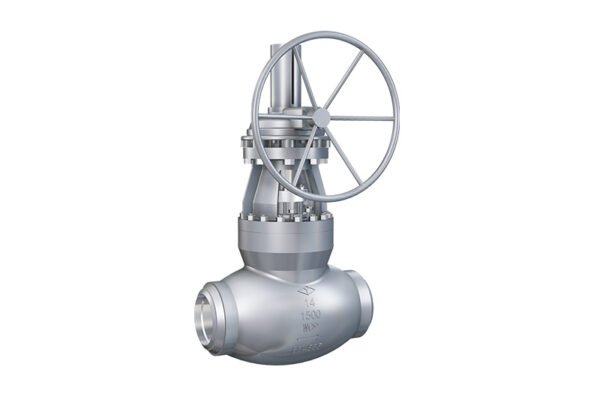
Product Parameters
| Nominal Diameter | 1/2″~16″(DN15~DN400) |
|---|---|
| Pressure Rating | CLASS 600~CLASS 2500(PN100~PN420) |
| Temperature Range | -29°C~500°C |
| Connection Type | Butt-weld, Flanged |
| Body Material | Carbon Steel, Alloy Steel, Stainless Steel, A105N, WCB, F11, WC6, F22, WC9, F321, F347, CF8C |
| Internal Material | F6a, F321, F347, Gr660, etc. |
| Sealing Surface Material | STL |
| Operation Mode | Handwheel, Bevel Gear, Electric, Pneumatic, etc. |
Technical Specifications
| High Pressure Hydrogenation Gate Valve | |
|---|---|
| Design Standards | JB/T 11484, NB/T 47044, GB/T 12224, GB/T 12235, JB/T 7746, ASME B16.34, API 623, API602, BS 1873 |
| Face-to-Face Dimensions | GB/T 12221, ASME B16.10 |
| Flange Connection | GB/T 9124.1, HG/T 20592, ASME B16.5 |
| Butt Weld Connection | GB/T 12224, ASME B16.25 |
| Material Requirements | NACE MR-0103, NACE MR-0175 |
| Pressure Testing and Inspection | GB/T 26480, GB/T 26481, API598, ISO 15848-2 |
Structural Features
high-pressure hydrogenation gate valve has the following features:
✔ Pressure self-sealing valve cover.
✔ Optional double packing with isolation ring.
✔ The sealing ring contact area is overlaid with a hard alloy layer to ensure reliable pressure self-sealing performance.
✔ Valve disc and valve seat sealing surfaces are overlaid with Stellite or Stellite-based hard alloy, providing wear resistance, high temperature resistance, corrosion resistance, and good friction resistance, resulting in a long service life.
✔ Valve stem is quenched and tempered with surface nitriding treatment, offering good friction and corrosion resistance.
✔ Medium and large diameters can adopt bypass structure or be designed as double valve disc structure (high inlet, low outlet).
✔ Electric valves are equipped with electric actuators featuring compact size, light weight, full functionality, and attractive appearance. They can be used with programmable computers and can be optionally equipped with electric actuators according to user requirements.
High Pressure Hydrogenation Gate Valve Structure Diagram
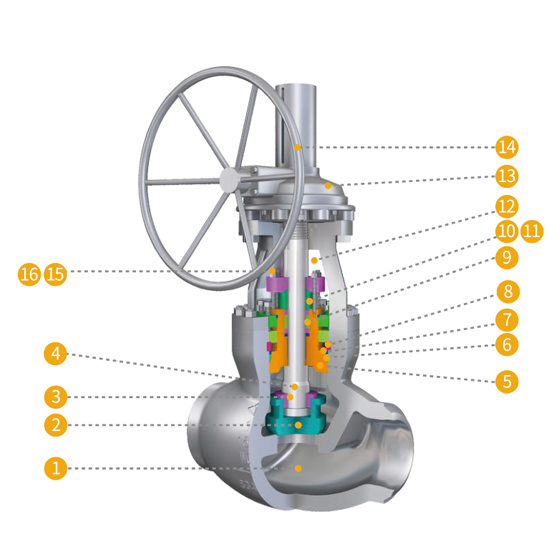
Parameter Information
01. Valve Body
02. Valve Disc
03. Valve Disc Gland
04. Valve Stem
05. Valve Cover
06. Sealing Ring
07. Stainless Steel Washer
08. Four-Split Retaining Ring
09. Packing
10. Packing Gland
11. Packing Gland Flange
12. Bracket
13. Actuator
14. Dust Cover
15. Bolt 16. Nut
Design Features
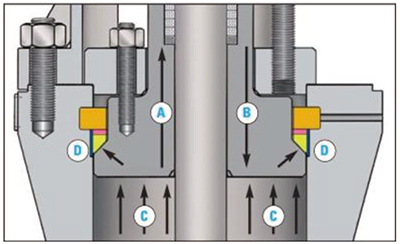
▶ Basic Principle of Pressure Sealing Valve Operation
⊙ A and B valve covers tend to move up or down with pressure changes.
⊙ C system pressure.
⊙ D sealing force caused by system pressure plus bolt preload.
⊙ The higher the internal pressure, the greater the sealing force and the better the sealing performance.
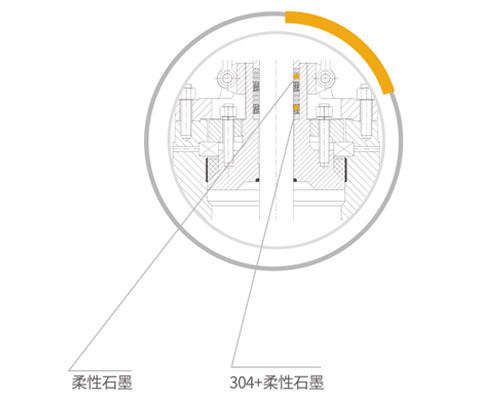
▶ High Pressure Hydrogenation Gate Valve Packing Seal Structure
⊙ Increase packing depth and quantity to improve packing sealing performance.
⊙ Packing is selected from top domestic brands or even imported brands, such as Shandong Binzhou, GARLOCK, to improve packing quality.
⊙ Improved assembly process: since flexible graphite rings are relatively loose microscopically, each packing piece is pre-compressed before assembly and pressed with a special tool at 28MPa to compact each packing piece, ensuring long-lasting sealing.
⊙ Improved packing structure: two rings of graphite + stainless steel braided packing are placed at the bottom of the packing box to utilize their higher strength (compared to pure flexible graphite rings) to prevent graphite from being extruded into the valve cavity and outside. Above the packing, three rings of pure flexible graphite are added to reduce friction on the valve stem and lower the opening torque. Two more rings of graphite packing are added above the flexible graphite rings, creating a multi-layer sealing effect and improving valve stem packing sealing performance.
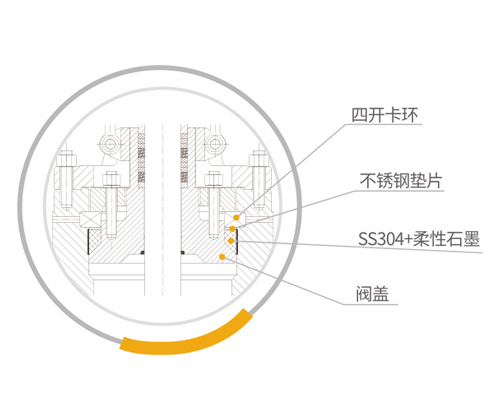
▶ High Pressure Hydrogenation Gate Valve Self-Sealing Structure
⊙ The connection between the valve body and valve cover adopts a pressure self-tightening sealing structure, with a wedge-shaped sealing ring combined with a four-split ring to achieve long-lasting sealing.
⊙ A stainless steel washer is added to the upper part of the wedge-shaped sealing ring to make the contact force between the four split retaining rings and the sealing ring more uniform, preventing deformation of the sealing ring under high pressure due to uneven force.
⊙ Hard alloy is deposited by welding on the corresponding parts of the valve body, forcing the sealing ring to deform under high pressure to achieve reliable sealing; the higher the pressure, the more reliable the seal.
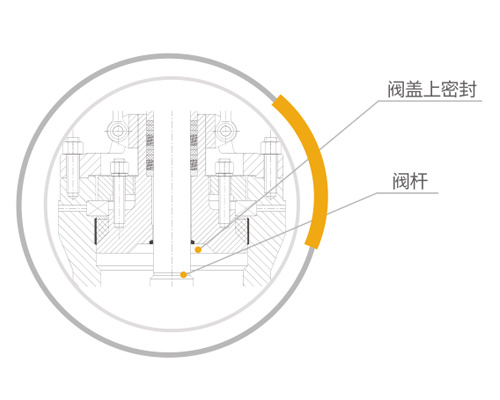
▶ High-pressure hydrogenation gate valve stem process
⊙ The valve stem is integrally forged. Suitable for high temperature and high pressure conditions. Due to unstable medium temperature, certain temperature differences may occur. The integrally forged valve stem head has high tensile strength, and increased pulling force during valve plate opening will not cause the valve stem head to break, preventing the valve disc from being trapped in the valve body and unable to operate.
⊙ The valve stem undergoes heat treatment to meet design performance requirements. The valve stem is entirely processed by CNC machine tools using special processing techniques to ensure design requirements such as roughness, coaxiality, and straightness; the opening torque of the valve is also a very important indicator of valve performance. Improving valve stem precision and packing quality can effectively reduce the valve closing torque, making valve operation flexible.
⊙ The valve stem thread uses rolled trapezoidal threads to improve thread strength and transmission performance.
⊙ The valve is equipped with an upper sealing structure. When the packing fails, the upper sealing structure can effectively provide safe sealing, ensuring the reliability of the valve seal. Our company has mature experience in selecting valve stem materials, controlling mechanical properties, and ensuring processing accuracy, with excellent valve operation performance.
Dimensional Data
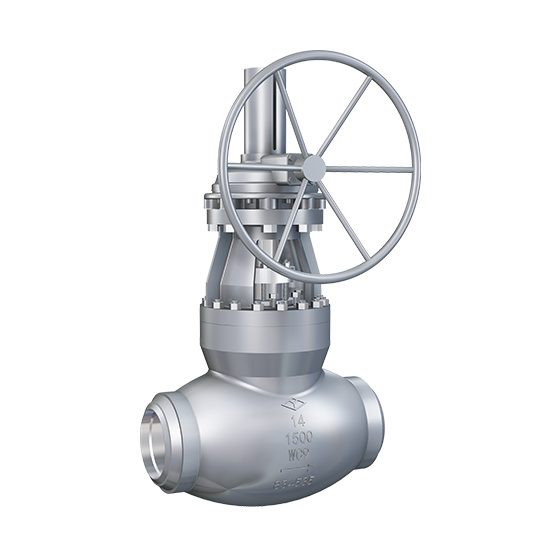
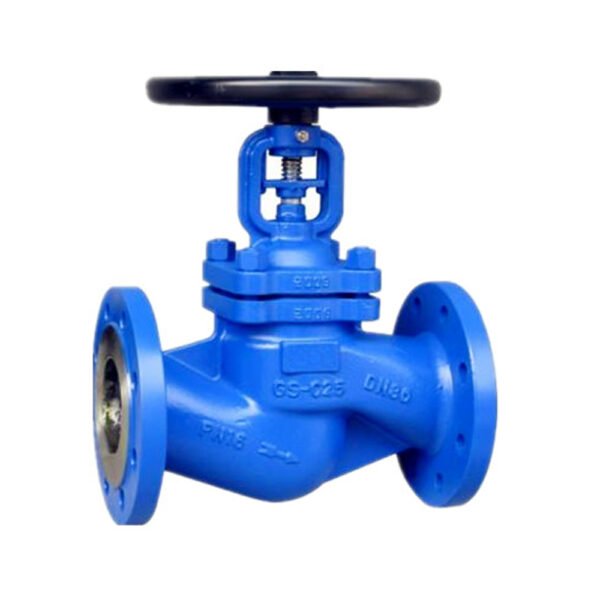
High-pressure hydrogenation globe valve
The high-pressure hydrogenation globe valve is suitable for high-pressure hydrogen service conditions with media such as hydrogen (containing hydrogen sulfide), hydrogen with fuel gas, and hydrogen with fuel products (containing hydrogen sulfide). Its nominal pressure is PN100 or Class 600, with the valve body flange and valve cover connected by flange bolts. For valves with nominal pressure ≥ PN160 or Class 900 and nominal size ≥ DN50, the design is an internal pressure self-sealing structure, with hard alloy deposited by welding on corresponding parts of the inner cavity where SS + flexible graphite or metal sealing rings are placed.

Reviews
There are no reviews yet.