
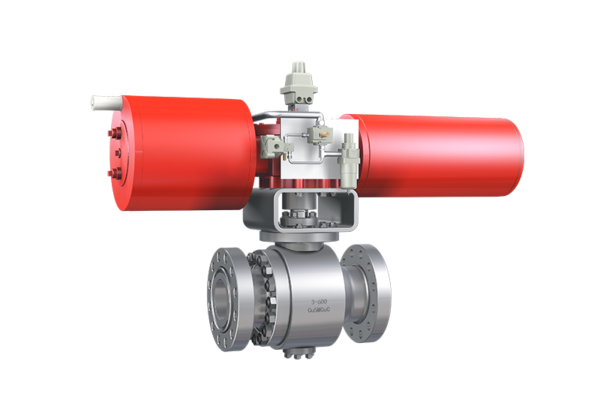
Product Parameters
| Nominal Diameter | Straight-through type, floating ball ½”~8″ (DN15~DN200); fixed ball 2″~20″ (DN50~DN500) |
|---|---|
| Pressure Rating | CLASS 150~CLASS 1500 (PN16~PN250) |
| Temperature Range | -196°C~400°C |
| Connection Type | Butt-weld, Flanged |
| Body Material | CF3, CF8M, CF3M, MONEL, etc. |
| Ball Seat Material | F304L, F316, F316L, Inconel 625, MONEL K500, and other special hardened treatments |
| Stem Material | F304L, F316, F316L, Inconel 625, MONEL K500, etc. |
| Leakage Class | ANSI B16.104/FCI 70.2 Class VI |
| Operation Mode | Manual, worm gear, pneumatic, electric, hydraulic, etc. |
Technical Specifications
| Design Basis | GB | API | ASME | |
|---|---|---|---|---|
| Design Standards | GB/T 12237 | API 608 | API 6D | ASME B16.34 |
| Face-to-Face Dimension | GB/T 12221 | ASME B16.10 | API 6D | ASME B16.10 |
| Flange Connection | HG/T 20592 | ASME B16.5 | ||
| Butt-weld Connection | GB/T 12224 | ASME B16.25 | ||
| Material Requirements | GB/T 20972.1 | NACE MR-0175 | ||
| Pressure Testing and Inspection | GB/T 26480 | API 598 | API 6D | ASME B16.34 |
| Fire Resistance Test | JB/T 6899 | API 6FA | ||
| Micro-leakage Test | GB/T 26481 B | ISO 15848-1 B | ||
Structure Classification
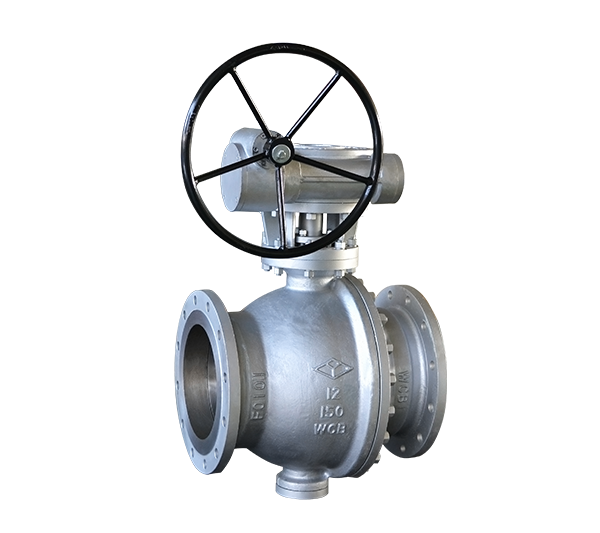
✔ Can be divided into floating ball structure and fixed ball valve. By applying special hardening treatment technology to the ball seat sealing surface, it completely overcomes the technical difficulties of hard alloy bonding in high-pressure, high-temperature ultra-pure gas applications. The valve operates smoothly without sticking, is degreased and de-oiled, waterproof and anti-static, and the sealing performance maintains a long-term Class VI leakage rating.
Two-piece Floating Structure
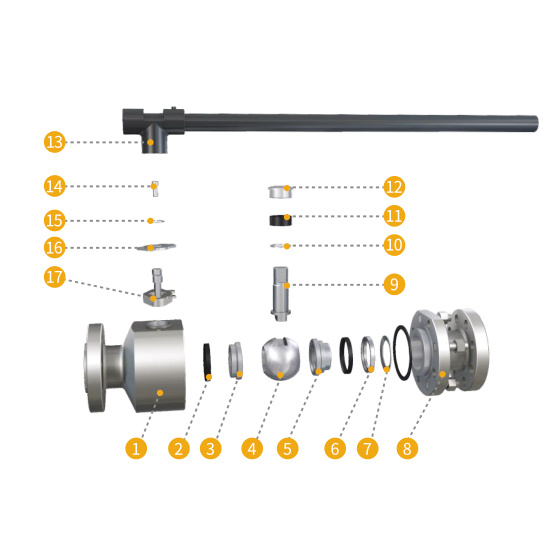
Two-piece Floating Structure
1. Left valve body 2. Seat sealing ring 3. Outlet seat 4. Ball 5. Inlet seat 6. Pressure ring 7. Disc spring 8. Right valve body 9. Stem 10. Thrust washer 11. Packing 12. Packing gland 13. Handle 14. Screw 15. Spring retaining ring 16. Limit plate 17. Packing follower
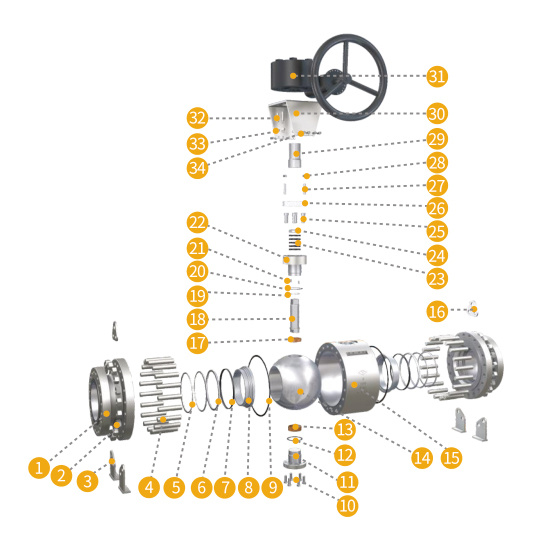
Three-piece Fixed Structure
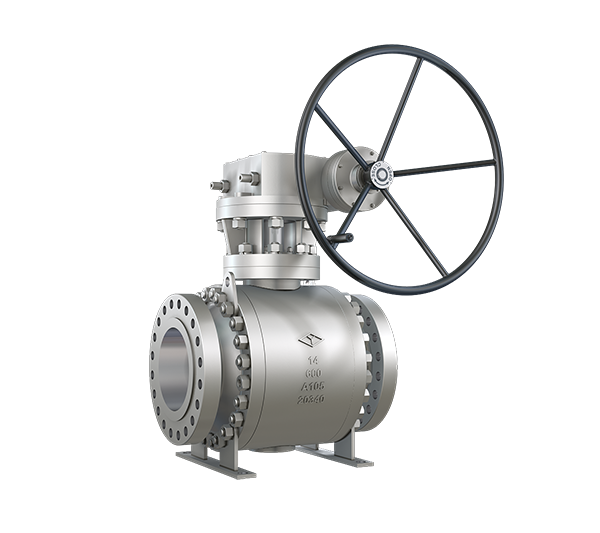
1. Valve cover 2. Hex nut 3. Support foot 4. Stud 5. Disc spring 6. Pressure ring 7. Seat sealing ring 8. Seat 9. Spiral wound gasket 10. Screw 11. Bottom shaft 12. Spiral wound gasket 13. Lower bushing 14. Ball 15. Valve body 16. Lifting lug 17. Upper bushing 18. Stem 19. Thrust washer 20. Spiral wound gasket 21. Dowel pin 22. Packing box 23. Packing 24. Packing gland 25. Screw 26. Packing follower 27. Stud 28. Hex nut 29. Coupling 30. Bracket 31. Worm gear box 32. Stud 33. Hex nut 34. Screw
Product Features
▶ Small diameters use floating ball structure, large diameters use fixed ball structure design.
The inner surface of the flow path through which the oxygen medium flows must be smooth, unobstructed, without edges, sharp corners, unevenness, or sudden changes. Internal valve parts have rounded edges, and the stem’s retraction groove is rounded to ensure no pressure spikes or flow direction changes during flow. No solid particles are allowed inside the valve body to prevent static electricity generation.
Special hard alloy formula: fully integrated with the base material, never peels off, with a post-processing thickness of no less than 0.4mm. Hardness can reach HRC61~64, with good oxidation resistance, thermal conductivity, electrical conductivity, low friction coefficient after degreasing, low heat generation, completely solving metal bonding issues. Specially designed for oxygen, nitrogen, and hydrogen valves.
▶ Complete fireproof structure design
The sealing surface of the metal hard-sealed ball valve adopts a metal-to-metal sealing structure, the packing uses flexible graphite, and the gasket uses stainless steel + flexible graphite winding. Therefore, the valve can ensure reliable sealing even in the event of a fire.
▶ Reliable stem design
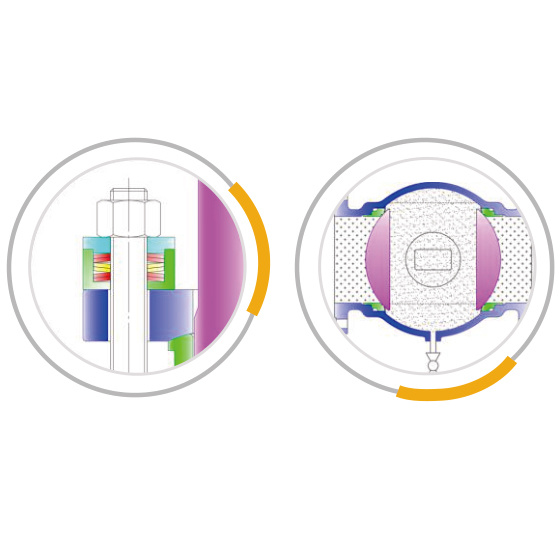
▶ Central flange quantitative compression design
Stem explosion-proof spray safety design
Targeted stem wear-resistant design
Safety factor design of more than 2 times
90° quick switch
▶ Reasonable sealing surface width design
Carefully calculated the minimum sealing surface width that can withstand the required sealing force.
▶ Reliable anti-static structure design
To ensure the sealing and operational safety of high-temperature and high-pressure oxygen valves, all factors that generate static electricity should be eliminated as much as possible. This makes the high-temperature and high-pressure oxygen valves have both good sealing and safe anti-static performance.
Quantitative preloaded dynamic active load sealing patent (Patent No. ZL202121859290.7) design: The quantitatively compressed group in the enclosed space provides continuous sealing preload for the packing, which can automatically compensate for packing leakage caused by changes in packing due to valve operation, temperature and pressure cycles, and time-related packing volume changes.
▶ Central cavity automatic pressure relief design
⊙ After the valve is closed, when the pressure in the valve’s central cavity is higher than the closing pressure, the annular surface formed by the outer diameter of the valve seat sealing ring and the middle diameter of the valve seat seal is pushed open by the medium pressure in the central cavity on the lower pressure side, achieving automatic pressure relief and ensuring valve safety.
▶ Floating ball is equipped with a unidirectional sealing structure by default, fixed ball is equipped with a bidirectional sealing structure by default.
▶ All parts in contact with oxygen are made of nickel-based alloys or ultra-low carbon austenitic stainless steel.
▶ Fixed ball is equipped with dual bearing positioning and protective structure design.
▶ The entire valve and parts undergo strict oil and grease removal.
▶ Actuator and accessory design
Select high-performance valve actuators according to the medium’s working conditions to meet the requirements, and choose original imported solenoid valves, position switch transmitters, air filter pressure reducing valves, and other accessories.
Dimensional data
Oxygen ball valve
The gasifier is the core device of the coal gasification unit. The combustion pressure inside the gasifier is 4.0~6.3MPa, and the temperature is 1100~1300°C. It is a highly dangerous device. Therefore, the safety and reliability of the gasifier are the top priority. Secondly, to ensure the stability of the reaction products, the slurry and oxygen flow entering the gasifier must be precisely controlled.
The reaction inside the gasifier is a high-temperature and high-pressure combustion reaction that requires a large amount of oxygen. To ensure normal combustion and safe operation of the gasifier, the oxygen flow must be precisely controlled. Generally, three oxygen valves are configured to control the oxygen flow entering the gasifier: oxygen flow control valve, oxygen shut-off valve, and oxygen vent valve. Compared with general industrial process oxygen valves, the oxygen shut-off valve for the gasifier needs to withstand high pressure differences, large flow rates, and strict sealing levels. The maximum shut-off pressure difference of the oxygen shut-off valve can reach 5.0~7.0MPa, and the leakage level needs to reach level V. Generally, such shut-off valves use straight-through O-type hard-sealed ball valves.

Reviews
There are no reviews yet.